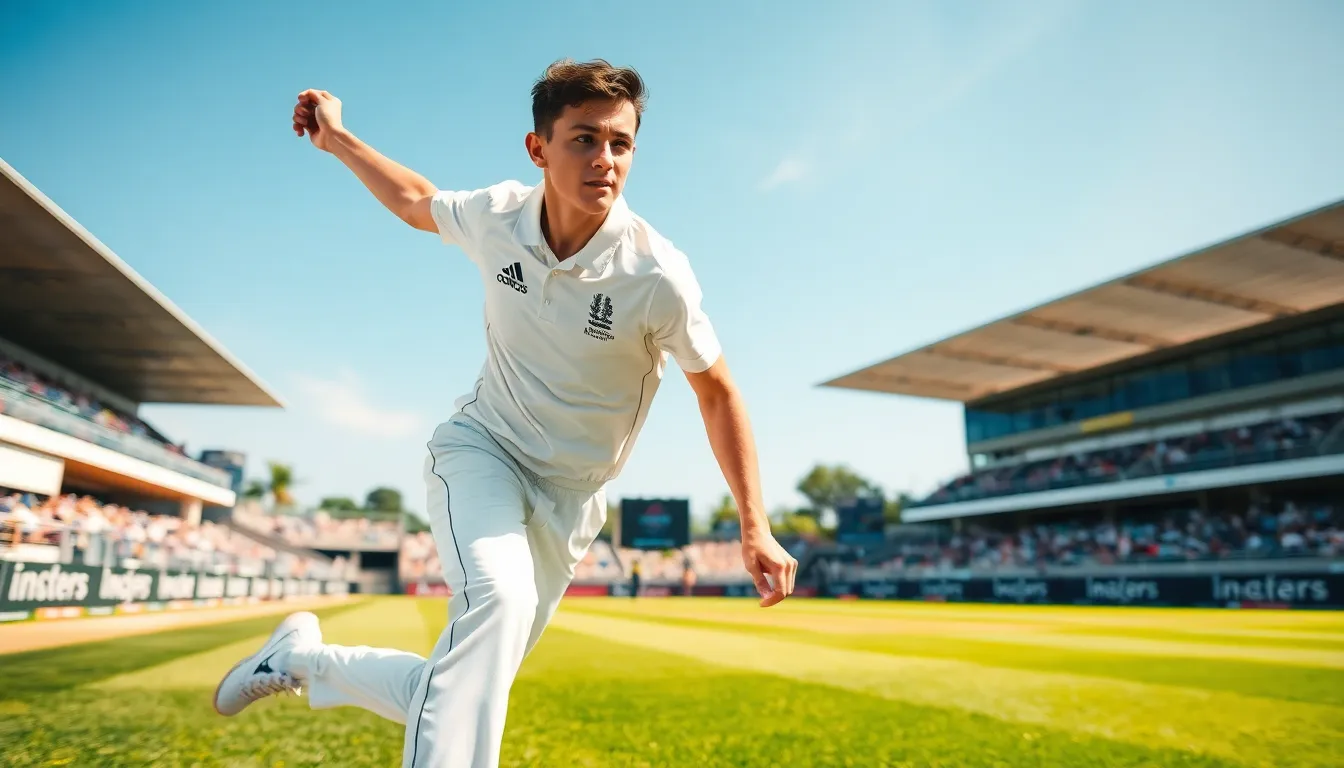
Have you ever watched a match and felt your heart race as a bowler speeds in like a comet, sending the ball zooming past the batsman? Fast bowling is an art form that captivates cricket fans and invokes sheer awe. It’s not just about how fast they can throw a ball: it’s about technique, precision, and, of course, a little bit of magic. So, buckle up as we jump into the world fastest bowler unraveling records, advancements in tech, and the thrill of the chase.
Overview of Fast Bowling

Defining Fast Bowling
Fast bowling is the part of cricket that transforms the green field into a stage for feats of speed and agility. Here, bowlers launch the ball down the pitch at speeds that can leave spectators, both in the stands and at home, wondering if their eyes are deceiving them. Typically, a fast bowler delivers the ball at speeds exceeding 85 miles per hour (137 kilometers per hour). These players rely on a combination of strength, technique, and strategy to beat the batsman.
Importance in Cricket
Fast bowling plays a crucial role in the game, often tipping the scale in favor of one team over another. The thrill of watching a ball sizzle through the air and crash into the stumps is unforgettable. It can intimidate the batters, swing momentum in matches, and even lead to game-changing moments. As a cornerstone of cricket, fast bowlers not only challenge batsmen but also create pivotal turning points in matches, making the sport as exhilarating as it is unpredictable.
Records of Fastest Bowlers
Top Fast Bowlers in History
Throughout cricket history, several bowlers have carved their names into the record books with extraordinary speed. Legendary figures like Shoaib Akhtar from Pakistan, who clocked an astonishing 161.3 km/h (100.23 mph) in 2003, set a benchmark that still holds tight. Australia’s Brett Lee and England’s Jofra Archer have also dazzled fans with their blistering pace, showing that this fast-bowling race is always evolving. Each generation brings new talent, pushing boundaries and redefining what it means to be fast.
Current Fastest Bowler
Currently, the title for the fastest bowler belongs to the bouncing young star, Avesh Khan. His recent records indicate he has hit speeds just over 150 km/h (93 mph) regularly, thrilling audiences every match. As fast bowling continues to evolve, these elite athletes are constantly in pursuit of breaking records, fueling excitement among fans and players alike.
Technological Advances in Measuring Speed
Impact of Technology on Performance
Advancements in technology have transformed how we understand and measure speed in cricket. What once relied solely on human observation is now tracked using sophisticated radar guns and motion sensors. This technology provides real-time data that fans and analysts can access, making it possible to celebrate those lightning throws with precision. Enhanced video analysis also lets bowlers assess their technique, helping them refine their skills for greater speed and accuracy.
Limitations of Speed Metrics
But, as exciting as this tech is, it has its limitations. Measuring speed accurately can be somewhat tricky due to factors like wind resistance, accuracy of the device, and environmental conditions during a match. Also, speed alone doesn’t determine a bowler’s effectiveness: control, swing, and tactics are equally important in creating a complete fast bowler.